
Real estate website seo structure audit
What this page covers
Real estate website seo structure audit
A real estate website SEO structure audit reviews how a US real estate site is organized for search, including hubs, listing pages, location pages, detail pages, and site depth.
Radar benchmarks include large US real estate and home services sites such as BuildZoom and RE/MAX with A scores, and Compass with a B score.
In brief
- Use the audit to measure your real estate site structure, including total pages, hubs, leaf pages, detail pages, empty hubs, and depth.
- Compare your architecture with US real estate SEO benchmarks such as BuildZoom, RE/MAX, and Compass instead of reviewing pages one by one.
- Treat the findings as a structure-focused SEO review. It can clarify organization, but it does not replace content, links, local SEO, or conversion work.
What to do
A practical real estate website SEO structure audit starts with a clear map of the site. Radar uses structure signals such as nodes, hubs, leaf pages, detail pages, depth, and empty hubs to show how well pages are grouped into useful sections.
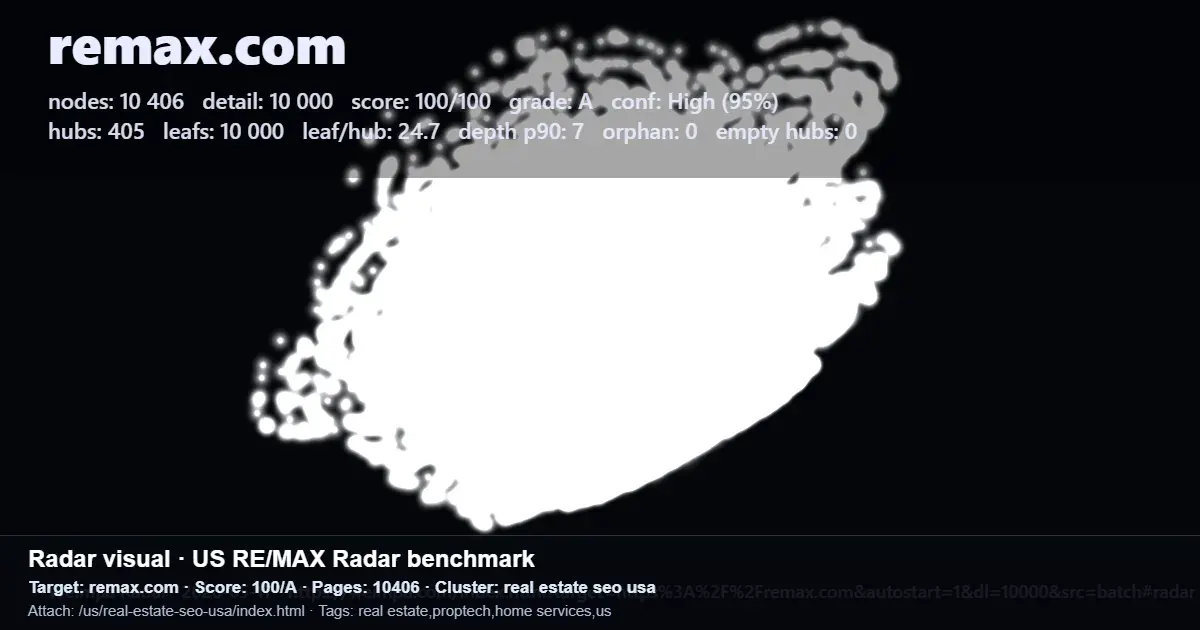
The benchmark examples show different patterns in the US real estate SEO cluster. BuildZoom is listed with 10,050 pages, 363 hubs, 9,686 leaf pages, and a 100/A score. RE/MAX is listed with 10,406 pages, 405 hubs, 10,000 leaf pages, and a 100/A score.
Compass appears in the same cluster with 10,003 pages, 2 hubs, 10,000 leaf pages, and a 72/B score. That contrast makes the audit useful for checking whether a real estate site has enough meaningful hubs for the number of pages it contains.
What to keep in mind
The strongest available benchmark detail is for large US real estate, proptech, and home services sites. The audit is most useful when a site has enough locations, listings, service areas, or detail pages for structure patterns to matter.
The audit should stay focused on website structure. The available benchmark signals support analysis of pages, hubs, leaf pages, depth, scores, and empty hubs, but they do not prove rankings, traffic growth, lead volume, or revenue outcomes.
If your real estate site is much smaller than the benchmarked domains, the comparison can still guide structure decisions, but the findings should be scaled to your site size. A small site does not need to copy a 10,000-page architecture.